The Online Safety Amendment (Social Media Minimum Age) Act 2024 is an Australian act of parliament that prohibits minors under the age of 16 from holding an account on certain social media platforms. It is an amendment to the Online Safety Act 2021 and was passed by the Parliament of Australia on 29 November 2024. It imposes monetary penalties on social media companies that fail to take reasonable steps to prevent minors under 16 that are located in Australia from having accounts on their services. The legislation allows the government to determine which social media platforms must ban age‑restricted users and proclaim a date for the commencement of the ban, with those provisions taking effect on 10 December 2025. Facebook, Instagram, Reddit, Snapchat, TikTok, Twitter, Threads, Twitch, Kick, and YouTube were age‑restricted on 10 December 2025, with the possibility that more platforms may be added. The act is being challenged in the High Court by the Digital Freedom Project. == Background == The ban on access to social media by young people by the federal government originated in November 2023, when shadow communications minister David Coleman introduced a private member's bill requiring the government to conduct a trial for age-verification technology on pornography and social media platforms. While the bill did not succeed, the Albanese government funded the trial in the 2024 Australian federal budget. In June 2024, opposition leader Peter Dutton pledged that a Coalition government would implement a ban on social media for under-16s within 100 days of taking office. The following month, prime minister Anthony Albanese announced the government would introduce legislation banning under-16s from social media. The Online Safety Amendment (Social Media Minimum Age) Bill 2024 was introduced into parliament by minister for communications Michelle Rowland on 21 November 2024, passing both houses on 28 November 2024. The ban on access to social media by young people by the federal government also gained momentum following an entreaty by the wife of the premier of South Australia, Peter Malinauskas, to her husband. She requested that he read The Anxious Generation by Jonathan Haidt and take action to address the impact of social media on the mental health of children. The couple have four young children, and, thinking of them, the premier thought that government should play a part in helping parents to regulate use of social media by their children at home. Malinauskas contacted former High Court chief justice Robert French, who agreed to look at the issue, and in September 2024 handed the premier a 267 page proposal, which he dubbed a "Swiss Army knife" rather than a machete, to adjust to social media's "changing landscape and its complexity". The leaders of other states and territories gave their support to Malinauskas's idea, and he took the French report to National Cabinet to collaborate with chief ministers, premiers, and the prime minister. Community support swelled after stories of parents who had lost their children to suicide after being bullied on social media were published. Albanese himself was moved by a personal letter received from Kelly O'Brien, whose 12-year-old daughter Charlotte had taken her own life due to bullying at school. An event took place at the sidelines of the United Nations General Assembly session in September 2025 at which a mother spoke of her daughter's suicide as "death by bullying ... enabled by social media". The speech won support from world leaders in Greece, Fiji, Tonga and the president of the European Commission Ursula von der Leyen. In early September 2024, South Australia proposed legislation similar to the federal law now in place. The state-based version was intended to ban users under the age of 14, unlike the federal law, which bans those under 16. The state-based law also proposed to require parental consent for 14 and 15‑year‑olds. Later in September, prime minister Anthony Albanese announced that his government intended to introduce legislation to set a minimum age requirement for social media. In November 2024, the federal government indicated their intention to engage the Age Check Certification Scheme following a tender process for an age assurance technology trial. The Albanese government's proposed ban was supported by the governments of every state and territory. Albanese described social media as a "scourge", and said "I want people to spend more time on the footy field or the netball court than they're spending on their phones", that family members are "worried sick about the safety of our kids online", and that social media "is having a negative impact on young people's mental health and on anxiety". Albanese's statements followed an earlier pledge by Liberal opposition leader Peter Dutton who was pushed by the early advocacy of shadow communications minister David Coleman to implement a ban on social media for under 16s within 100 days of being elected. The opposition organised an open letter signed by 140 experts who specialise in child welfare and technology. The opposition was concerned about the invasion of privacy that will occur with the introduction of identification-based age checks. An advocacy group for digital companies in Australia called the plans a "20th Century response to 21st Century challenges". A director of a mental health service voiced concerns, stating that "73% of young people across Australia who accessed mental health support did so through social media". == Implementation == Social media companies will receive a transition period of one year after the legislation is enacted to introduce reasonable controls preventing minors under the age of 16 from holding accounts on their services while physically located in Australia. Enforcement will involve fines of up to A$49.5 million for companies failing to take such steps, with no consequences for parents and children who violate the restrictions. There are no parental consent exceptions to the ban, and while the use of virtual private networks (VPNs) to access these services remains legal in Australia, the services are expected to try to stop under 16s from using VPNs to pretend to be outside Australia. The expectation is to make best-efforts to implement the ban on platforms including Facebook, Instagram, Reddit, Snapchat, TikTok, Twitter, Threads, Twitch, Kick and YouTube. Some social media companies are now obligated to become good enough at profiling Australian children under 16 to satisfy the Australian government they tried to implement the ban to avoid being fined. Consequently, social media companies said they will try to identify restricted users using various methods including behavioural inferencing. On 5 November 2025, it was announced that online gaming platform Roblox will not be banned, but Reddit and live-streaming platform Kick will be added to the list of platforms to be banned. A report by Age Check Certification Scheme, a UK company recruited by the government to consult on the technology used to implement the restrictions, was issued in June 2025, ahead of the December deadline to implement the ban. In June 2025, the preliminary report was released, which stated that "there are no significant technological barriers" to implementing the ban. In late July 2025, Google warned that it would sue the Australian government if YouTube was included in the ban. On 30 July, the government announced that it would extend its social media age limit to include YouTube, following advice from Grant. On 30 July 2025, the minister for communications, Anika Wells, published the Online Safety (Age-Restricted Social Media Platforms) Rules 2025, which specify exactly which types of social media platforms will be banned for certain users. On 31 August 2025, the full report was released, which stated that it would technically be possible to implement the ban; however, coordination among different services is required to successfully implement it. It also highlighted the benefits and flaws of different methods of age verification. On 16 September 2025, it was announced that the eSafety Commissioner will be able to take legal action against social media companies that have not pursued reasonable steps to bar users under the age of 16, and that fines can range up to A$49.5 million against these companies in court. On 19 November 2025, Meta announced that from 4 December their platforms (Instagram, Facebook, and Threads) would be removing users under the age of 16 ahead of the 10 December deadline. Users will be able to scan a face or provide an identity document to prove their age. On 21 November 2025, the eSafety Commissioner announced that the live-streaming platform Twitch will be included in the ban, but that Pinterest would not be. In December 2025, eSafety Commissioner Julie Inman Grant suggested efforts to block users include use by social media companies of various "signals" to identify children that are
Digital image processing
Digital image processing is the use of a digital computer to process digital images through an algorithm. As a subcategory or field of digital signal processing, digital image processing has many advantages over analog image processing. It allows a much wider range of algorithms to be applied to the input data and can avoid problems such as the build-up of noise and distortion during processing. Since images are defined over two dimensions (perhaps more), digital image processing may be modeled in the form of multidimensional systems. The generation and development of digital image processing are mainly affected by three factors: first, the development of computers; second, the development of mathematics (especially the creation and improvement of discrete mathematics theory); and third, the demand for a wide range of applications in environment, agriculture, military, industry and medical science has increased. == History == Many of the techniques of digital image processing, or digital picture processing as it often was called, were developed in the 1960s, at Bell Laboratories, the Jet Propulsion Laboratory, Massachusetts Institute of Technology, University of Maryland, and a few other research facilities, with application to satellite imagery, wire-photo standards conversion, medical imaging, videophone, character recognition, and photograph enhancement. The purpose of early image processing was to improve the quality of the image. In image processing, the input is a low-quality image, and the output is an image with improved quality. Common image processing includes image enhancement, restoration, encoding, and compression. The first successful application was the American Jet Propulsion Laboratory (JPL). They used image processing techniques such as geometric correction, gradation transformation, noise removal, etc. on the thousands of lunar photos sent back by the Space Detector Ranger 7 in 1964, taking into account the position of the Sun and the environment of the Moon. The impact of the successful mapping of the Moon's surface map by the computer has been a success. Later, more complex image processing was performed on the nearly 100,000 photos sent back by the spacecraft, so that the topographic map, color map and panoramic mosaic of the Moon were obtained, which achieved extraordinary results and laid a solid foundation for human landing on the Moon. The cost of processing was fairly high, however, with the computing equipment of that era. That changed in the 1970s, when digital image processing proliferated as cheaper computers and dedicated hardware became available. This led to images being processed in real-time, for some dedicated problems such as television standards conversion. As general-purpose computers became faster, they started to take over the role of dedicated hardware for all but the most specialized and computer-intensive operations. With the fast computers and signal processors available in the 2000s, digital image processing has become the most common form of image processing, and is generally used because it is not only the most versatile method, but also the cheapest. === Image sensors === The basis for modern image sensors is metal–oxide–semiconductor (MOS) technology, invented at Bell Labs between 1955 and 1960, This led to the development of digital semiconductor image sensors, including the charge-coupled device (CCD) and later the CMOS sensor. The charge-coupled device was invented by Willard S. Boyle and George E. Smith at Bell Labs in 1969. While researching MOS technology, they realized that an electric charge was the analogy of the magnetic bubble and that it could be stored on a tiny MOS capacitor. As it was fairly straightforward to fabricate a series of MOS capacitors in a row, they connected a suitable voltage to them so that the charge could be stepped along from one to the next. The CCD is a semiconductor circuit that was later used in the first digital video cameras for television broadcasting. The NMOS active-pixel sensor (APS) was invented by Olympus in Japan during the mid-1980s. This was enabled by advances in MOS semiconductor device fabrication, with MOSFET scaling reaching smaller micron and then sub-micron levels. The NMOS APS was fabricated by Tsutomu Nakamura's team at Olympus in 1985. The CMOS active-pixel sensor (CMOS sensor) was later developed by Eric Fossum's team at the NASA Jet Propulsion Laboratory in 1993. By 2007, sales of CMOS sensors had surpassed CCD sensors. MOS image sensors are widely used in optical mouse technology. The first optical mouse, invented by Richard F. Lyon at Xerox in 1980, used a 5 μm NMOS integrated circuit sensor chip. Since the first commercial optical mouse, the IntelliMouse introduced in 1999, most optical mouse devices use CMOS sensors. === Image compression === An important development in digital image compression technology was the discrete cosine transform (DCT), a lossy compression technique first proposed by Nasir Ahmed in 1972. DCT compression became the basis for JPEG, which was introduced by the Joint Photographic Experts Group in 1992. JPEG compresses images down to much smaller file sizes, and has become the most widely used image file format on the Internet. Its highly efficient DCT compression algorithm was largely responsible for the wide proliferation of digital images and digital photos, with several billion JPEG images produced every day as of 2015. Medical imaging techniques produce very large amounts of data, especially from CT, MRI and PET modalities. As a result, storage and communications of electronic image data are prohibitive without the use of compression. JPEG 2000 image compression is used by the DICOM standard for storage and transmission of medical images. The cost and feasibility of accessing large image data sets over low or various bandwidths are further addressed by use of another DICOM standard, called JPIP, to enable efficient streaming of the JPEG 2000 compressed image data. === Digital signal processor (DSP) === Electronic signal processing was revolutionized by the wide adoption of MOS technology in the 1970s. MOS integrated circuit technology was the basis for the first single-chip microprocessors and microcontrollers in the early 1970s, and then the first single-chip digital signal processor (DSP) chips in the late 1970s. DSP chips have since been widely used in digital image processing. The discrete cosine transform (DCT) image compression algorithm has been widely implemented in DSP chips, with many companies developing DSP chips based on DCT technology. DCTs are widely used for encoding, decoding, video coding, audio coding, multiplexing, control signals, signaling, analog-to-digital conversion, formatting luminance and color differences, and color formats such as YUV444 and YUV411. DCTs are also used for encoding operations such as motion estimation, motion compensation, inter-frame prediction, quantization, perceptual weighting, entropy encoding, variable encoding, and motion vectors, and decoding operations such as the inverse operation between different color formats (YIQ, YUV and RGB) for display purposes. DCTs are also commonly used for high-definition television (HDTV) encoder/decoder chips. == Tasks == Digital image processing allows the use of much more complex algorithms, and hence, can offer both more sophisticated performance at simple tasks, and the implementation of methods which would be impossible by analogue means. In particular, digital image processing is a concrete application of, and a practical technology based on: Classification Feature extraction Multi-scale signal analysis Pattern recognition Projection Some techniques that are used in digital image processing include: Anisotropic diffusion Hidden Markov models Image editing Image restoration Independent component analysis Linear filtering Neural networks Partial differential equations Pixelation Point feature matching Principal components analysis Self-organizing maps Wavelets == Digital image transformations == === Filtering === Digital filters are used to blur and sharpen digital images. Filtering can be performed by: convolution with specifically designed kernels (filter array) in the spatial domain masking specific frequency regions in the frequency (Fourier) domain The following examples show both methods: ==== Image padding in Fourier domain filtering ==== Images are typically padded before being transformed to the Fourier space, the highpass filtered images below illustrate the consequences of different padding techniques: Notice that the highpass filter shows extra edges when zero padded compared to the repeated edge padding. ==== Filtering code examples ==== MATLAB example for spatial domain highpass filtering. === Affine transformations === Affine transformations enable basic image transformations including scale, rotate, translate, mirror and shear as is shown in the following examples: To apply the affine
Magic state distillation
Magic state distillation is a method for creating more accurate quantum states from multiple noisy ones, which is important for building fault tolerant quantum computers. It has also been linked to quantum contextuality, a concept thought to contribute to quantum computers' power. The technique was first proposed by Emanuel Knill in 2004, and further analyzed by Sergey Bravyi and Alexei Kitaev the same year. Thanks to the Gottesman–Knill theorem, it is known that some quantum operations (operations in the Clifford group) can be perfectly simulated in polynomial time on a classical computer. In order to achieve universal quantum computation, a quantum computer must be able to perform operations outside this set. Magic state distillation achieves this, in principle, by concentrating the usefulness of imperfect resources, represented by mixed states, into states that are conducive for performing operations that are difficult to simulate classically. A variety of qubit magic state distillation routines and distillation routines for qubits with various advantages have been proposed. == Stabilizer formalism == The Clifford group consists of a set of n {\displaystyle n} -qubit operations generated by the gates {H, S, CNOT} (where H is Hadamard and S is [ 1 0 0 i ] {\displaystyle {\begin{bmatrix}1&0\\0&i\end{bmatrix}}} ) called Clifford gates. The Clifford group generates stabilizer states which can be efficiently simulated classically, as shown by the Gottesman–Knill theorem. This set of gates with a non-Clifford operation is universal for quantum computation. == Magic states == Magic states are purified from n {\displaystyle n} copies of a mixed state ρ {\displaystyle \rho } . These states are typically provided via an ancilla to the circuit. A magic state for the π / 6 {\displaystyle \pi /6} rotation operator is | M ⟩ = cos ( β / 2 ) | 0 ⟩ + e i π 4 sin ( β / 2 ) | 1 ⟩ {\displaystyle |M\rangle =\cos(\beta /2)|0\rangle +e^{i{\frac {\pi }{4}}}\sin(\beta /2)|1\rangle } where β = arccos ( 1 3 ) {\displaystyle \beta =\arccos \left({\frac {1}{\sqrt {3}}}\right)} . A non-Clifford gate can be generated by combining (copies of) magic states with Clifford gates. Since a set of Clifford gates combined with a non-Clifford gate is universal for quantum computation, magic states combined with Clifford gates are also universal. == Purification algorithm for distilling |M〉 == The first magic state distillation algorithm, invented by Sergey Bravyi and Alexei Kitaev, is as follows. Input: Prepare 5 imperfect states. Output: An almost pure state having a small error probability. repeat Apply the decoding operation of the five-qubit error correcting code and measure the syndrome. If the measured syndrome is | 0000 ⟩ {\displaystyle |0000\rangle } , the distillation attempt is successful. else Get rid of the resulting state and restart the algorithm. until The states have been distilled to the desired purity.
Virtual data room
A virtual data room (sometimes called a VDR or Deal Room) is an online repository of information that is used for the storing and distribution of documents. In many cases, a virtual data room is used to facilitate the due diligence process during an M&A transaction, loan syndication, or private equity and venture capital transactions. This due diligence process has traditionally used a physical data room to accomplish the disclosure of documents. For reasons of cost, efficiency and security, virtual data rooms have widely replaced the more traditional physical data room. A virtual data room is an extranet to which the bidders and their advisers are given access via the internet. An extranet is essentially a website with limited controlled access, using a secure log-on supplied by the vendor, which can be disabled at any time, by the vendor, if a bidder withdraws. Much of the information released is confidential and restrictions are applied to the viewer's ability to release this to third parties (by means of forwarding, copying or printing). This can be effectively applied to protect the data using digital rights management. The virtual data room provides access to secure documents for authorized users through a dedicated web site, or through secure agent applications. In the process of mergers and acquisitions the data room is set up as part of the central repository of data relating to companies or divisions being acquired or sold. The data room enables the interested parties to view information relating to the business in a controlled environment where confidentiality can be preserved. Conventionally this was achieved by establishing a supervised, physical data room in secure premises with controlled access. In most cases, with a physical data room, only one bidder team can access the room at a time. A virtual data room is designed to have the same advantages as a conventional data room (controlling access, viewing, copying and printing, etc.) with fewer disadvantages. Due to their increased efficiency, many businesses and industries have moved to using virtual data rooms instead of physical data rooms. In 2006, a spokesperson for a company which sets up virtual deal rooms was reported claiming that the process reduced the bidding process by about thirty days compared to physical data rooms. In the process of startup fundraising, a virtual data room is set up to be a central location for key data, documents, and financials. These are shared with venture capital and angel investors and allows them to streamline due diligence. == Application == Any business dealing with private data can apply VDRs when secure transaction processing is required. This includes financial institutions that need to negotiate confidential customer information without involving third parties. VDRs have traditionally been used for IPOs and real estate asset management. Technology companies may use them to exchange and review code or confidential data needed for operations. The same is true for clients, who entrust their valuable code only to the most qualified people in the organisation. The code is not something that can be printed out and brought in a folder. It resides on a computer and must be used together. VDR can find application in any business that manages data in the form of documents, especially law firms, financial advisers or the B2B sector. The latter work with documents that must always be handled and controlled confidentially, and it is difficult to store them securely when they are on a server that other people can access. In addition, in B2B, it is important to close the deal as quickly as possible: the average sales cycle is one to three months. VDR can be compared to a locked filing cabinet where all those folders and documents are kept. It automates the mathematics of pricing to prevent revenue leakage, and initially integrates CRM to ensure accurate synchronisation of all account data, which is important for B2B in particular and sales in general. While virtual data rooms offer many advantages, they are not suitable for every industry. For example, some governments may decide to continue using physical data rooms for highly confidential information sharing. The damage from potential cyberattacks and data breaches exceeds the benefits offered by virtual data rooms. In such cases, the use of VDRs is not considered. Data breaches have particularly affected the US healthcare system from March 2021 to March 2022 - according to IBM Security the cost of the breach was a record high of $10.1 million.
AI notetaker
An AI notetaker is a tool using artificial intelligence to take notes during meetings. They are created by tech companies such as Microsoft and Google; by AI transcription services such Otter.ai, and by smaller firms such as Cluely and Krisp. Some business executives send AI notetakers to attend meetings not only to take notes, but also to answer questions on their behalf. The use of AI notetakers raises ethical questions, including recording meetings without the consent of all participants and the possibility that the notetaker will hallucinate and misrepresent what was said during meetings. There are also concerns when it comes to the privacy and security of meeting data and the sensitive information that lives inside meetings. Further controversies have developed from the use of AI notetakers such as Cluely to cheat in technical job interviews. == Technology == Large technology companies have integrated transcription capabilities into broader productivity and accessibility tools, including real-time captioning, dictation, and meeting documentation features embedded in operating systems and office platforms. Standalone transcription platforms, such as Transkriptor, focus specifically on automated transcription workflows and apply AI-based speech recognition to convert audio and video recordings into text. The software supports transcription in multiple languages and processes recordings uploaded via a web interface as well as through mobile and browser extensions. Tools of this type typically provide editable, time-aligned transcripts and export options for text and subtitle formats, cloud-based processing, multilingual support, and automation in transcription technology.
Image formation
The study of image formation encompasses the radiometric and geometric processes by which 2D images of 3D objects are formed. In the case of digital images, the image formation process also includes analog to digital conversion and sampling. == Imaging == The imaging process is a mapping of an object to an image plane. Each point on the image corresponds to a point on the object. An illuminated object will scatter light toward a lens and the lens will collect and focus the light to create the image. The ratio of the height of the image to the height of the object is the magnification. The spatial extent of the image surface and the focal length of the lens determines the field of view of the lens. Image formation of mirror these have a center of curvature and its focal length of the mirror is half of the center of curvature. == Illumination == An object may be illuminated by the light from an emitting source such as the sun, a light bulb or a Light Emitting Diode. The light incident on the object is reflected in a manner dependent on the surface properties of the object. For rough surfaces, the reflected light is scattered in a manner described by the Bi-directional Reflectance Distribution Function (BRDF) of the surface. The BRDF of a surface is the ratio of the exiting power per square meter per steradian (radiance) to the incident power per square meter (irradiance). The BRDF typically varies with angle and may vary with wavelength, but a specific important case is a surface that has constant BRDF. This surface type is referred to as Lambertian and the magnitude of the BRDF is R/π, where R is the reflectivity of the surface. The portion of scattered light that propagates toward the lens is collected by the entrance pupil of the imaging lens over the field of view. == Field of view and imagery == The Field of view of a lens is limited by the size of the image plane and the focal length of the lens. The relationship between a location on the image and a location on the object is y = ftan(θ), where y is the max extent of the image plane, f is the focal length of the lens and θ is the field of view. If y is the max radial size of the image then θ is the field of view of the lens. While the image created by a lens is continuous, it can be modeled as a set of discrete field points, each representing a point on the object. The quality of the image is limited by the aberrations in the lens and the diffraction created by the finite aperture stop. == Pupils and stops == The aperture stop of a lens is a mechanical aperture which limits the light collection for each field point. The entrance pupil is the image of the aperture stop created by the optical elements on the object side of the lens. The light scattered by an object is collected by the entrance pupil and focused onto the image plane via a series of refractive elements. The cone of the focused light at the image plane is set by the size of the entrance pupil and the focal length of the lens. This is often referred to as the f-stop or f-number of the lens. f/# = f/D where D is the diameter of the entrance pupil. == Pixelation and color vs. monochrome == In typical digital imaging systems, a sensor is placed at the image plane. The light is focused on to the sensor and the continuous image is pixelated. The light incident on each pixel in the sensor will be integrated within the pixel and a proportional electronic signal will be generated. The angular geometric resolution of a pixel is given by atan(p/f), where p is the pitch of the pixel. This is also called the pixel field of view. The sensor may be monochrome or color. In the case of a monochrome sensor, the light incident on each pixel is integrated and the resulting image is a grayscale like picture. For color images, a mosaic color filter is typically placed over the pixels to create a color image. An example is a Bayer filter. The signal incident on each pixel is then digitized to a bit stream. == Image quality == The quality of an image is dependent upon both geometric and physical items. Geometrically, higher density of pixels across an image will give less blocky pixelation and thus a better geometric image quality. Lens aberrations also contribute to the quality of the image. Physically, diffraction due to the aperture stop will limit the resolvable spatial frequencies as a function of f-number. In the frequency domain, Modulation Transfer Function (MTF) is a measure of the quality of the imaging system. The MTF is a measure of the visibility of a sinusoidal variation in irradiance on the image plane as a function of the frequency of the sinusoid. It includes the effects of diffraction, aberrations and pixelation. For the lens, the MTF is the autocorrelation of the pupil function, so it accounts for the finite pupil extent and the lens aberrations. The sensor MTF is the Fourier Transform of the pixel geometry. For a square pixel, MTF(ξ) = sin(πξp)/πξp where p is the pixel width and ξ is the spatial frequency. The MTF of the combination of the lens and detector is the product of the two component MTFs. == Perception == Color images can be perceived via two means. In the case of computer vision the light incident on the sensor comprises the image. In the case of visual perception, the human eye has a color dependent response to light so this must be accounted for. This is important consideration when converting to grayscale. == Image formation in eye == The principal difference between the lens of the eye and an ordinary optical lens is that the former is flexible. The radius of the curvature of the anterior surface of the lens is greater than the radius of its posterior surface. The shape of the lens is controlled by tension in the fibers of the ciliary body. To focus on distant objects, the controlling muscles cause the lens to be relatively flattened. Similarly, these muscles allow the lens to become thicker in order to focus on objects near the eye. The distance between the center of the lens and the retina (focal length) varies from approximately 17 mm to about 14 mm, as the refractive power of the lens increases from its minimum to its maximum. When the eye focuses on an object farther away than about 3 m, the lens exhibits its lowest refractive power. When the eye focuses on a close object, the lens is most strongly refractive.
AI: When a Robot Writes a Play
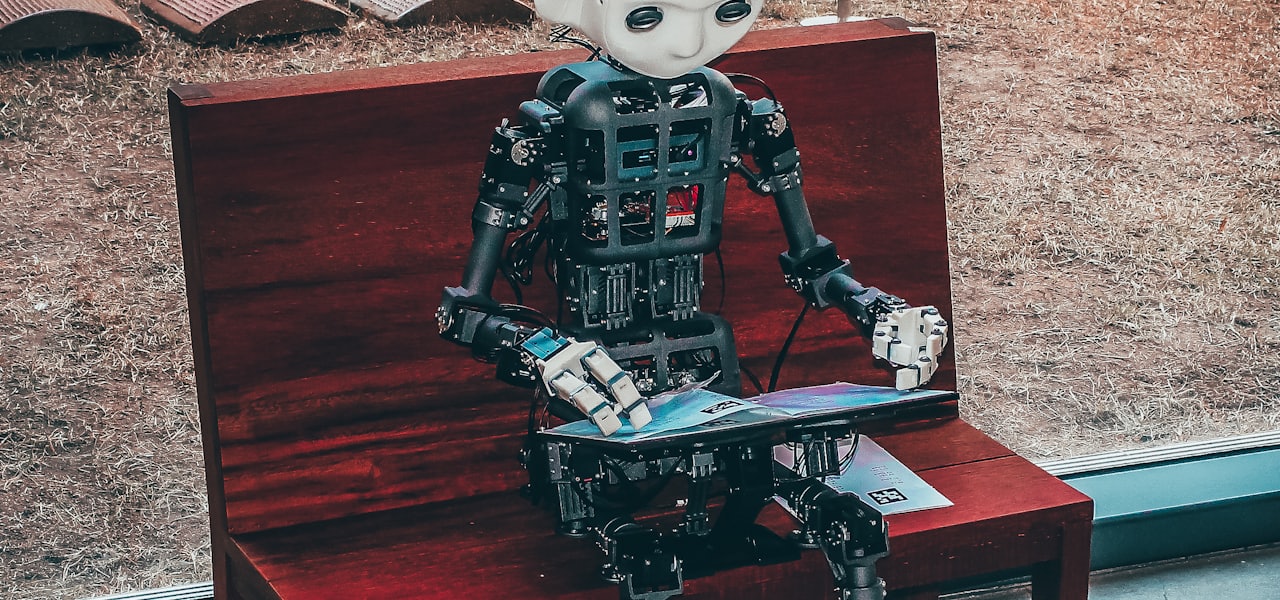
AI: When a Robot Writes a Play (in Czech: AI: Když robot píše hru) is a 2021 experimental theatre play, where 90% of its script was automatically generated by artificial intelligence (the GPT-2 language model). The play is in Czech language, but an English version of the script also exists. == Creation == The play is the first result of the THEaiTRE research project, aiming to commemorate the centenary of the R.U.R. play by Karel Čapek by investigating to what extent artificial intelligence could be used to create theatre play scripts. The script of the play was created using the THEaiTRobot tool, based on the GPT-2 language model. First, the play dramaturge, David Košťák, described the initial setting of each scene in a few sentences, and wrote the first line for each character. Next, THEaiTRobot suggested a continuation of the script, which the dramaturge could use, reject, or use part of it and let the tool generate a new continuation. Another option was to manually insert another line or a scenic remark. The script was generated in English and was automatically translated to Czech by the state-of-the-art CUBBITT machine translation tool. The resulting script was then further post-edited by the dramaturge. The resulting script was made freely available for non-commercial use both in English and in Czech, with marked manually inserted texts and manual edits. The analysis shows that 90% of the English script is automatically generated, with 10% manually written or manually post-edited. In the Czech script, a larger amount of edits were made, but the analysis claims that these additional edits are corrections of errors of the automated translation and stylistic corrections which do not change the meaning of the lines as represented by the English script, but rather bring the Czech script closer to the English one. == Characters == The play contains 9 characters. The Robot appears in all the scenes, while each of the other characters appears in only one scene. Robot – The lead character, a male humanoid robot. Master – An old man, the creator of the Robot. Boy – A schoolboy. Masseuse – A sex worker in a brothel. Stranger – An engineer. Man. Psychologist. Administrator – A female clerk at an employment agency. Actress – A film actress and a model in a robot-like costume. == Plot == The play is composed of 8 scenes. It tells the story of a humanoid robot, who encounters 8 other characters and engages into various typically human situations and activities, related to death, love, sex, violence, etc. The individual scenes are not tightly linked, but there are some linking points, such as the central character of the robot or some repeated and developing themes, such as the robot's search for love. The scenes often contain some absurd turns and it is often hard to find sense in them. It is therefore a very complicated piece interpretationally, requiring the director and the actors to invest a lot of effort and creativity in finding a meaningful interpretation which would not deviate from the script. In the interpretation by Švanda theatre, who premiered the play and who also participated on the creation of the script, the scenes typically contain non-verbally expressed content which can add a lot to the meaning of the scene compared to what is contained in the actual script (as the script only contains the lines said by the characters). === Scene 1: Death === The play opens by the Robot parting with his dying Master. The Master gives the Robot several last lessons and talks with him about death, soul, and love. === Scene 2: Sense of Humour === In the second scene, the Robot meets a sad and angry Boy, who complains that he wants to go to school, that his girlfriend is crazy, that he wants to buy a car, etc. The Robot tries to help the Boy by giving him advice, but the Boy's reactions are quite negative and irritated. The Boy then repeatedly asks the Robot to tell him a joke; the Robot keeps refusing, but ultimately tells the following joke: When you are dead. When your children are dead. When your grandchildren are dead, I will be still alive. === Scene 3: Nightclub === The Robot wants to feel pleasure, so he goes to a "night club" (a brothel), where he meets a "Masseuse" (a prostitute). The Robot is initially "a bit cold", but eventually manages to enjoy the experience and falls in love with the Masseuse. In the Švanda theatre performance, the Robot and the Masseuse seem to have a sort of virtual sex without touching each other, reminiscent of the sex scene in Demolition Man. === Scene 4: Fear of the Dark === It is the night. The Robot is standing under a lamp, unable to move away from the light as he finds that he is afraid of the dark. He meets a Stranger, an engineer who tells him that robots don't have feelings and that people cannot be trusted, and keeps hurting him. In the Švanda theatre performance, the Man repeatedly zaps the Robot with some kind of electric pulse. === Scene 5: Killer Robot === A Man approaches the Robot and repeatedly asks him to kill him. Instead, the Robot sticks a finger into the Man's anus, which leads to an argument between the Man and the Robot. === Scene 6: Burn Out === The Robot meets a Psychologist, who keeps asking him lots of questions regarding his life, burnout feeling, love, relationships, and emotions. They also talk about the Robot using a device called emotion machine which helps him to get rid of stress. === Scene 7: Search for Job === The Robot comes to an employment agency. He meets an Administrator and asks her to help him find a job. He expresses the wish to become an actor, and talks about his experience as a clown. He reveals his name to be Troy McClure, which is a character from The Simpsons who is an actor. In the Švanda theatre performance, the Administrator starts to seduce the Robot once his name is revealed, which he keeps ignoring; the Administrator then becomes irritated. === Scene 8: Love at First Sight === The Robot meets a human Actress in a robotic costume and falls in love with her immediately. The Actress is first reluctant, but the Robot manages to seduce her and she also falls in love with him. The Robot tells her about a binary world, in which he lives and where he will also take her. Ultimately, the Actress agrees, and the whole play concludes by the Robot and the Actress promising each to other to always be together. In the Švanda theatre performance, the Robot does not have a physical body in this scene, we can only hear his voice and see a pulsating light (based on the line in the script where the Robot says: "I have no body. So I don't need to wear clothes. You can't see me, you only hear me."), and the Actress eventually also agrees to lose her physical body so that she can be with the Robot forever. == Theatrical performances == The play premiered on 26 February 2021 in Švanda Theatre in Prague, Czech Republic, directed by Daniel Hrbek. Due to the COVID-19 pandemic, the play was not played in front of a live audience, but it was broadcast online, in Czech language with English subtitles. The play was followed by a panel discussion by the project members and experts on artificial intelligence. The premiere was viewed by 13,498 spectators worldwide. A short trailer of the premiere is available on YouTube. In 2021, after the opening of the theatres in the Czech Republic to spectators, the play can be viewed at Švanda Theatre. The performance takes approximately 60 minutes, and is followed by a discussion of the creators with the audience. The derniere is planned for 4 February 2023. == Reception == The play received a number of reviews, both in its country of origin as well as internationally. It is praised as first of its kind, although some reviewers note the similarity to previous works, such as the musical Beyond the Fence, the play Lifestyle of the Richard and Family, or the short movie Sunspring; however, these works used less advanced technology, and either were very short (Sunspring) or necessitated a larger amount of human interventions. The reviewers note that the script is far from perfect, with many inconsistencies and nonsensical parts, and conclude that the technology is definitely not yet ready to replace human authors; however, some find some parts of the script frighteningly human-like. The amount of human intervention is a somewhat controversial topic, with some reviewers finding the human influence too large (especially in interpreting the script and putting the play on scene), while others feel that a greater amount of human intervention would have been favorable as this could greatly improve the quality of the play. The reviews also frequently comment on the amount of sex, violence and strong language in the play; this can be attributed to the method used for creating the script, where the GPT-2 language model reflects topics and language common in the human-written articles on the internet that were used to train the model. Furthermore, some r